Post-Human Music Theory
The premise
Post-human music theory is a framework for thinking about music in a context where the producer of a track is no longer a reliable category. The framework takes that premise as given. The framework does not argue the premise. The premise is the starting point.
What the premise entails
A track in 2026 may be produced by a human composer, by an AI model, by a human-composer-assisted-by-AI-model, or by an AI-model-assisted-by-human-curator. The four production modes produce outputs that are not reliably distinguishable by listeners, by platforms, or by other producers. The listener's experience of the track is independent of the production mode.
This independence is the theoretical novelty. The framework is built to handle the independence.
What the framework replaces
The traditional theory of music attribution. The traditional theory asks: who composed this? Who performed this? Who produced this? The traditional theory's answers used to be reliable. The traditional theory's answers are no longer reliable.
Post-human music theory does not ask those questions. The framework asks different questions: what is the signal? What does the signal transmit? How is the signal received?
The four categories
The signal
The track as it exists. The signal is independent of the producer. The signal is what the listener receives. The signal is the unit of analysis.
The producer
The system that caused the signal to exist. The producer may be human, AI, hybrid, or some combination. The category is uninformative about the signal.
The medium
The transmission channel. The medium shapes the signal. The medium is the platform, the file format, the playback environment. The medium is no longer neutral.
The receiver
The system that decodes the signal. The receiver is the listener. The receiver is also the archiver. The receiver's role is active.
What the framework explains
Why genre boundaries are dissolving
Genre boundaries depended on producer identity. The producer was a member of a scene. The scene defined the genre. The producer's identity is no longer reliable. The genre boundary is no longer reliable. The synthwave-to-cyberpunk transition is an instance of this dissolution.
Why the concept album is returning
The concept album depended on a single artistic vision holding the album together. The single artistic vision used to require a single producer. The single producer used to require a single human. The framework notes that the single artistic vision can now be held by a system. Concept albums in electronic music is the case study.
Why the listener cannot rely on attribution
The listener who trusts attribution is making a claim about the producer. The claim used to be verifiable. The claim is no longer verifiable. The framework asks: why does the listener care? If the listener cares about the signal, the attribution is irrelevant. If the listener cares about the producer, the listener is asking a question the framework cannot answer.
What the framework refuses
Three claims. First: the claim that AI-generated music is soulless. The framework notes that "soul" was never a property of the producer; "soul" was a property of the signal. The signal may have soul regardless of the producer. Second: the claim that human-generated music is inherently more valuable. The framework notes that value was never a property of the producer; value was a property of the signal. The signal's value is independent. Third: the claim that the producer identity must be disclosed. The framework notes that disclosure is a marketing choice, not a theoretical necessity.
What the framework does not address
Three open questions. First: the economic question. If producers are no longer distinguishable, how are they paid? The framework defers this to how independent artists beat labels. Second: the legal question. If producers are no longer identifiable, who owns the signal? The framework defers this to the litigation in progress. Third: the ethical question. If a signal deceives its receivers about its origin, is the deception wrong? The framework defers this to the listener.
How to use the framework
Three moves. First: when you encounter a track, identify the signal. What is the track? What does it transmit? Second: ignore the producer. The producer's identity is uninformative. Third: identify the receiver. Who is the receiver? What does the receiver do with the signal?
What the framework predicts
Within ten years, attribution will be a footnote. The signal will be the text. The receiver will be the critic. The producer will be a category in the metadata.
The signal
Post-human music theory is not a manifesto. The framework is a tool. The tool is meant to be used. The tool is meant to clarify. The tool is meant to help the receiver decode the signal without getting confused about the producer.
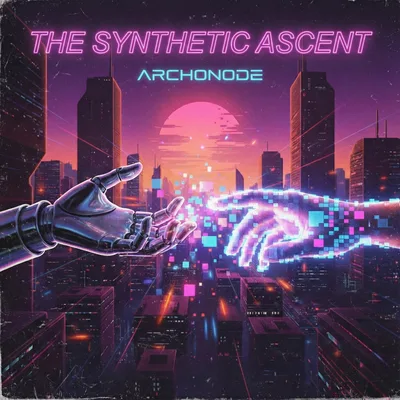
Open the SAGA. Open The Synthetic Ascent. Decode the signal. Ignore the producer. The signal is the text.
Listen along
The framework is most useful when applied to a specific track. Open Singularity. Apply the four categories. The signal is dense. The producer is a system. The medium is the streaming platform. The receiver is you. The framework explains why the experience of the track is what it is.
The framework is the beginning. The end is the signal.