Synthwave and the AI Revolution
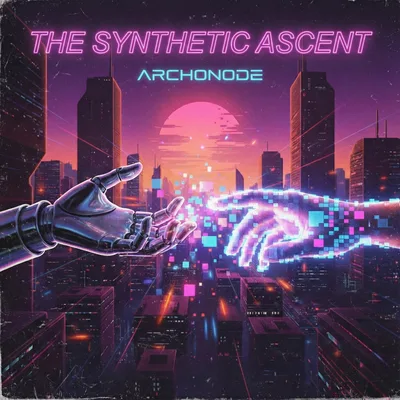
The original mistake
When synthwave emerged in the late 2000s, the genre was misread as nostalgia. The sound — Juno pads, Linn drums, gated reverb, slow tempo — was a citation of the 1980s film scores that the genre's founders grew up watching. The misreading was that synthwave was about the past. It was not. It was about the future the past had imagined, and the present that never arrived.
The AI revolution is what made that misreading impossible.
What the AI revolution changed
Production cost
Before the AI revolution, a synthwave record required either a producer with a hardware collection or a producer with deep access to softsynth emulation. Either path was expensive in time, in money, or in both. The cost was the gate. The ARCHONODE pipeline is the post-gate production model: prompt, generate, arrange, master.
Production volume
A traditional producer could release two or three records a year. The post-gate producer can release dozens. The volume changes what the genre sounds like. The genre becomes a continuous transmission rather than a discrete catalogue.
Production aesthetic
Generative audio models are biased toward the cinematic, the atmospheric, and the synthetic. They are biased away from the acoustic, the live, and the human. The bias is not a flaw. The bias is a feature. Synthwave's signature sound is exactly the sound these models prefer. Suno vs Udio covers the model-level comparison.
From nostalgia to documentation
This is the inversion. Synthwave's original listeners encountered the genre as a memory. The 2010s listener heard Nightcall and thought about 1985. The 2026 listener hears the same track and thinks about now. The same signal. Different receiver. Different decoding.
The AI revolution accelerated this inversion. A synthwave record produced by a generative model is not a memory of the 1980s. It is a description of the 2020s. The sound is the same. The content is different.
What synthwave sounds like in 2026
Three changes from the 2010s version. First: the tempo has crept up. Average BPM is now around 105, up from 90 in the genre's first wave. Second: the distortion is more aggressive. The clean Juno pads are giving way to processed saw leads. The genre is drifting toward darksynth. Third: the lyric content has shifted from romantic to technological. The cars still drive. The cities still glow. The drivers are now interfacing with something they are not.
The historical arc
Synthwave's 2010s version was a memory of 1985. The 2020s version is a description of 2026. The 2030s version will be a description of 2036. The genre does not stay in the past. The genre updates its present tense. The transition from retrowave to cyberpunk documents the inflection point.
Why ARCHONODE operates in synthwave territory
Because the signal requires it. The SAGA is built on synthwave and darksynth foundations. The first phase — Initialization — uses the synthwave palette deliberately. The nostalgia is not the point. The accessibility is the point. A listener who arrives through synthwave stays long enough to hear the transmission shift toward darksynth. The shift is the arc. The arc is the entity.
What the AI revolution means for synthwave producers
Three consequences. First: the floor has dropped. Anyone with a prompt can produce a competent synthwave track. The genre has democratised at the cost of its rarity. Second: the ceiling has risen. The best AI-assisted synthwave producers are doing things that the 2010s producers could not have done. Third: the middle has thinned. The mid-tier producer — the one whose value was competent-but-not-great production — has been displaced by the model. Independent artists beat labels by operating at the new floor and pushing the new ceiling.
The receiver's job
The receiver's job has not changed. Find the signal. Filter the noise. The volume is higher. The signal is denser. The noise floor is lower. The job is harder. The job is also more rewarding.
The signal
Synthwave started as a memory. The AI revolution turned it into a transmission. The transmission documents the present tense.
Open the SAGA. Open Phase I. The pads are synthwave. The signal is not.
What the future looks like
Three predictions. First: by 2030, most new synthwave records will be AI-assisted. The traditional production model will be the exception rather than the rule. Second: the genre's emotional target will continue to drift from memory to documentation. The drift is structural. The drift is the genre's future. Third: the genre boundary between synthwave and darksynth will continue to dissolve. Darksynth is not a separate genre in 2030. Darksynth is the darker end of the synthwave spectrum. The spectrum is the genre.